Monday, July 13, 2009
It's really something when you need to paint to feel good. Guilty. The other day, while making preparations for my departure, I was feeling a little blue. What did I need to do? You guessed it. I needed to paint.
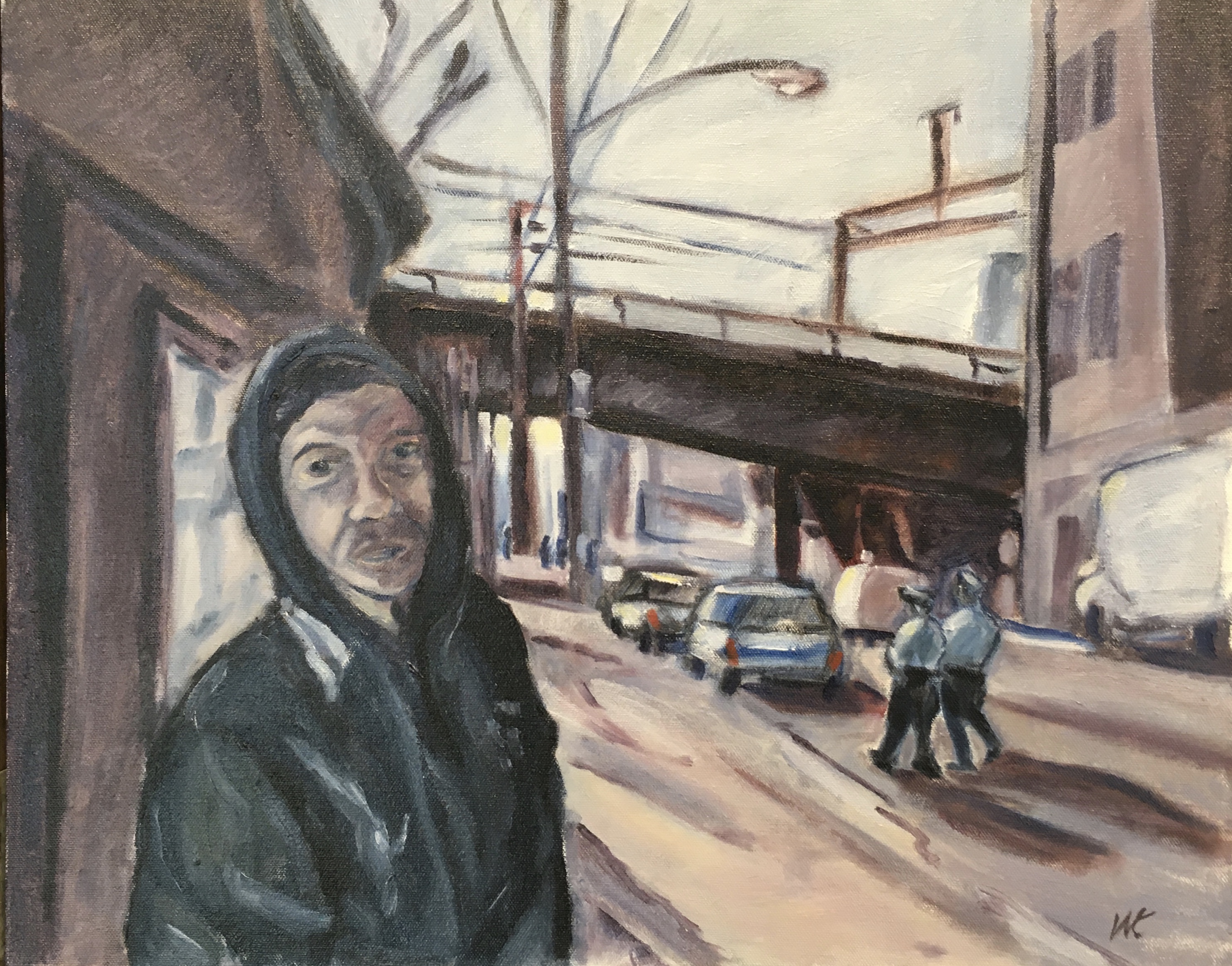
So, I decided to begin one more of the paintings for my Brooklyn series. This is a work in progress. I think it needs some more work, and no title comes to mind.
But I want to tell you that painting it was a pleasure. I felt very free, and I think I'm starting to capture the subject's expression. He is, as you might guess, a fish monger, and he's one of those merchants who is a pillar of his community, and he seems like a very nice person.
And that might explain why I painted with pleasure and a good measure of confidence. He sent out good vibes, which I picked up. So, even thought a good bit of time has passed, I still felt involved in the painting.
Anyway, thanks for putting up with my obsession, but isn't that he way painters are supposed to be.
Thanks for listening.
Best,
William Kosman
Wednesday, July 01, 2009
#23: Really Big Challenges from Brooklyn
At the outset, I want to apologize for my long silence. In fact, there are several reasons. First of all, I know that a true artist is devoted to his art above all, but I had some personal things going on. This is not the place for it, but I want you to know that these personal events were of the most positive nature. The second reason is that I've taken on some big challenges, and when I say big, I mean big.
Please look at the three paintings above. Two of the paintings - "Prayer 2" and "Did you hear . . ?" - are physically big. Compared with "Red Tights," which is 24 by 30 inches, the other two are a little larger than four foot by four foot. I wanted to throw myself into very large format, and I chose the series on Crown Heights, Brooklyn, for the change to bigger works.
I can tell you that working in such a large format is more complicated than just painting bigger. I learned that I had to change my way of thinking; I learned that a different set of rules take over. And I learned that I cannot simply boost the size from a smaller work to a larger work, as I initially tried with "Prayer 2."
And there are other things going on. I believe that I am achieving more and more freedom in my colors, brushstroke and in the ways I render objects and figures. For some reason, I believe that the very large format loosened up my work. You simply have to move more, and the act of swinging that brush around made me feel very free. Also, at least for me, when working on such a large format, there is little danger of getting fussy about achieving realistic details, which is certainly not one of my goals. I like painting that looks like painting. Seeing full brush strokes and free shapes of color give me pleasure. And I hope that they also give you - the viewer - the same pleasure. And, as far as color is concerned, the large format makes me feel freer to work in more colors.
Another thing that has been influencing me is time. I've been working on this series about Brooklyn for quite a while, for one reason or another, one reason being my dislocated finger. I see more and more proof that the farther away I am in time from my first impressions, the further away I can feel from some paintings. Of course this is true. The ideas, the impressions, the memories, the emotions are further in the past and are less real to me.
All except for the factor of emotion. Like any painter or individual, I have emotional responses to what I see, what I sketch and what I photograph. And, in so many cases, that emotion lives on in some cases with a certain intensity. Take, for example, the largest fiture in "Did you hear . . ?" I was impressed by the folds in the material of her swinging skirt. I wanted a great deal to try to get that feeling across, not the detail but the feeling. I'll bet I could wait a year and still painting that material in a convincing manner. Another example is the little girl in "Red Tights." I got such a positive feeling from seeing the mother and daughter together.
Of course, some artists work in formats exceeding four by four feet, which might even be small by some standards. But now, when I attack a larger format, I hope that my work is more successful, that is, gets the emotions across to you, the viewer, in a freer and more convincing way.
By the way, you may not hear from me for a while. For me, summers mean France, and I don't know if I'll be able to make new blog postings from there this year.
As always, I love hearing your ideas.
Thanks for listening.
Best,
William Kosman
Sunday, April 19, 2009
#22: Visit My Studio May 2-3, and More Details from Brooklyn
First of all, I want to invite all of you to visit my studio (#407) and the studios of other artists at 915 Spring Garden St.(at Percy St., near 9th St.), Philadelphia, PA 19123, from noon to 5 pm, on Saturday and Sunday, May 2 and 3. More than 40 artists in our building will be opening their studios and will be ready to talk with you about their work. In particular, I will really enjoy talking with you about my work, hearing your ideas and explaining what I have been trying to achieve in a more personal setting.
Among the paintings you will be able to see are these paintings of the Lubavitch Community in Brooklyn, and I hope to have produced more of this series by the time the Open Studios Event arrives in two weeks.
These paintings have been a new kind of experience for me. Yes, I consistently try to develop my style and perfect each painting I do as an individual work. But there is something more. There is the desire to represent a community, to show some of the individuals and the groups, and give hints about how they interact.
For example, in "Red Tights" I wanted to show the enthusiasm, cuteness and pure joy of the little girl with her mother. As in any painting, I place the figures where they attract the viewer's attention and where they fit into the scene. There is the choice of the colors, bright and lively, because it was a beautiful day and the sun was shining, and it was striking the way the light came through the trees, and how the light coming from the back threw the shadows forward. I will be working on this some more this coming week.
But in addition, there is the detail. Yes, the overall composition is important, but the smallest detail, the smallest change in the brush stroke, its width and its direction, the texture and the color of each space, can change the expression of the people and the mood they transmit.
And there is something very strange, very reassuring about painting and people. When the painting, or any detail in it, is wrong, you know it. And when it's right, when it clicks, you know it even more. The feeling of achievement, of having done something decent, crosses you like a wave.
Frankly, I believe I did capture something in the little girl.
In "Discussion," I was struck both by the ordinariness and the beauty of the scene. Two people - two men in this case - stop to chat on a street corner. Common, but yet so reassuring. The act of communication is so important. And with the sun catching them and throwing their shadows to one side, I found the scene engaging.
"Brooklyn Street Scene" was started just a few days ago. I think it is interesting. Girls who attend the Beth Rivkah school in Crown Heights wear long, purple skirts. Here we see two walking away from us, and two whispering to each other at the side of the sidewalk. Here, I'm trying to capture the movement of the girls as they walk, and just the right gesture of the other girls talking. Again, a very ordinary scene, but very engaging. Again, it was winter, with warm coats and trees bare of leaves, but it was sunny and the sky was cloudless.
I hope to complete the painting within two weeks. It's a big painting, four feet by four feet, but the size of the canvas may actually speed my work, because I feel a great deal of freedom working on that scale.
Remember, you can get closer to any painting by simply clicking on the painting. And then using back to return to the normal size.
As always, I'd love to hear your ideas.
Thanks for listing.
Best,
William Kosman
Monday, March 16, 2009
#21: A View of the Lubavitch Community
First of all, I want to explain why I have been silent for an entire month.
A while ago, I decided I would do a series of paintings representing several different aspects of life in the Lubavitch community. While Philadelphia has a growing Lubavitch community, I decided to spend several days in Crown Heights, Brooklyn.
Well, I believe everything happens for a reason. I was welcomed into the community with a great deal of warmth and understanding for my art. Because of this, I was able to participate in different aspects of Lubavitch life, and in many cases, take a lot of photographs that I would use - along with my sketches - to paint some of the scenes of my visit.
Apparently, I needed more time to reflect on the meaning of what I had seen. That is the explanation I believe is valid for what happened. One evening, walking with my sister to a reception, I stumbled and fell on an uneven sidewalk next to a construction site. In the process of breaking my fall, I dislocated a finger on my right hand. Even though the emergency physician was able to reset the joint, I did have to wait a while before I could resume painting.
The painting I really wanted to do first was "Prayer." It was the biggest challenge, but it was also one of the most meaningful. I wanted to be able to reflect the belief, devotion and the sincerity of the men attending a small synagogue in Crown Heights. It was a big challenge from many points of view - composition, color, detail, texture. I could bore you about why I made certain decisions, but basically I had to decide how to size and place the figures, and then adapt the colors and style.
Right now, I am working on several other paintings in this series, but I believe the series could expand to five, seven or even more paintings. As I said, everyone was wonderful with me, and I have a lot of ideas and material for more paintings. For the hospitality, help, warmth and encouragement I received, I would like to thank my family and the other members of the Lubavitch community.
The other painting, the small one called "Bouquet," just happened. It was a scene in our living room here in Philadelphia that just hit me as beautiful. I just had to paint it. I did it on a small panel, and the painting just painted itself.
I've learned that my painting is at its best when a painting just happens naturally.
As always, thanks for listening. And, as always, I love to hear from you.
Best,
William Kosman
Friday, February 13, 2009
#20: The Human Face
What I am about to say has been said many, many times. It has been felt deeply many, many times. It has been written about, and sung about, and most certainly painted many, many times. But here I am. I am going to say it one more time.
The human face is an amazing thing.
It is a great pleasure for me to paint faces. Painting a face, and trying to express the person's character and emotions and situation is - for me - the greatest challenge in painting.
While painting a portrait, I can make just the smallest changes, just extend a line near the eye, or enlarge a small spot of color, and the impact of the face changes, the expression changes. I can just change a color, or extend a color closer to the eye or the nose, and suddenly the face is right, or it is wrong.
Transmitting what a person feels goes far beyond getting the proportions correct, even though this is important. And even though the artist can make the decision to alter what he or she sees to achieve a certain effect.
It's so important to be willing to experiment, to be willing to add a darker color here or use a different brush stroke there. Sometimes, while painting, I tell myself that if I try to change something, I may ruin what I have already achieved. But I have to force myself to keep pushing.
The achievement is when everything clicks, and the person suddenly comes alive, and you can see the emotion.
The top portrait is a woman with a bright, sparkling personality and a positive outlook on life. I think I did capture something of her, although I could go further.
The second portrait is yours truly. I had a self-portrait that I started maybe a year or so ago, and never completed. One painter, whose opinion I respect, told me that you should not rework paintings from the past, because your outlook and skill level have changed. So, I used the unfinished self-portrait as practice. There is something of me there. Perhaps someone out there will have an opinion.
The landscape you see on the bottom has a story. I had constructed a frame with a wooden panel for another purpose, but the original purpose evaporated. I decided to copy a landscape from Normandy on it. The landscape is a view of the village of Reviers, one of the most beautiful scenes I've painted.
Painting on the smooth surface gave the landscape an entirely different feeling, both in the application of the paint and in the final appearance.
What do you think?
As always, I'd love to hear your reactions to these paintings. As always, thanks for your time and your continued support.
Best,
William Kosman
Friday, January 23, 2009
# 20: Back in the Groove
My Fellow Art Lovers:
What you're looking just above this text is a work in progress that is taking time to come to life.
I'm sure I've talked about this before: Like many other artists, and people in other fields also, I am not at the top of my game when I haven't painted for quite some time. The holidays were fine and wonderful for me, from a family point of view. But they were a setback from a professional point of view.
It really took time to get back in the groove.
The scene you see in this painting is right around the corner from my studio. In fact, it's the diner where I lunch pretty often. And at this diner, like at a million other locations around the world, when men see beauty, they turn to appreciate it.
For the light, for the setting, for the colors, and for the idea, I believe this is a valid painting.
I tried to get the idea across in the most interesting, artistic and pleasurable way. And, as always, there were some lessons in doing this painting, which I believe is perhaps 85 percent completed.
One of the lessons is persistence; I really had to fight to get back on track. (That, after in the groove, is cliche No. 2.)
Another one is patience; as I worked and thought and came up with new ideas and incorporated them into the composition and adjusted this and that, the painting got better. I think I have one more stage to go, because I just thought of more ways to make the painting even better.
And the last one I'll talk about is the creative act. When we listen to music, we can marvel at the fact that there are always new sounds possible - new melodies, new beats, new combinations - while the number of notes is limited. Of course, the same with books, even though the number of letters hasn't changed in a long time, and our language has only two million words.
It's the same with painting. I marvel at the fact that there are always new ideas and new ways to paint. Basically, an artist faces a blank canvas, and the only thing he can do is apply spots of colored oil to the canvas. But human beings can have such genius, such creativity, that even today, after hundreds of years, news things are happening, new forms and combinations are being used, new colors and textures are being developed.
In view of the great geniuses of our art, every artist has to be humble, and - believe me - I'm very, very humble. But even on my level, it's great to feel the surge of creativity once in a while.
My gosh, how did I get here?
Thanks for listening. Thanks for your support and interest. And, as always, your reactions are very, very welcome.
William Kosman
Wednesday, December 17, 2008
#19: The Artist Within
Fellow Art Lovers:
Once in a while, I am guilty of losing perspective. That is, I get involved with one idea, and then somehow I lose sight if the context and of the similar ideas that predated my current obsession. Well, that may be happening now.
You recall that I've written a lot about the style I want to attain. That's natural for a painter. The style, the particular brushstroke, the very surface of the painting, has a lot to do with the pleasure the viewer experiences. One of the reasons I believe people like my paintings done with a palette knife is that the texture is simply pleasing to look at. Well, I've gone on about this a lot on this blog, concluding that I should meld the two styles - palette knife and brush - into one, and in this way achieve the best of both worlds.
Now I know that a lot was wrong with my thinking. My experience with my latest portrait, which is "Untitled Portrait," has been very instructive to me.
While painting this portrait, I just felt good. I was at ease with myself. I had no major personal concerns, or I succeeded in keeping them out of my head. And every brushstroke not only seemed right, it also was a pleasure.
The conclusion I draw is this: The style is within me. I can try to achieve this or that style, but if I am in a state of mind that allows my trule style to come out, then it will. Peace of mind gives me the freedom to express myself.
This is what I also felt when I painted the two other portraits from last year. As in the most recent case, I also had positive feelings about the other two subjects. I just can't imagine succeeding with a portrait if I don't feel good about the person I am painting. And, trying to regain some of the perspective I might now be losing, I must have learned a lot in the interval.
Like composition. Some of my artist friends told me that the head jutting into the top shadow and the cup jutting upward keep the entire painting connected. This was not the mark of genius. It just seemed right at the time. The same with the placement of the figure. It felt right.
Like brushstroke. Of course, I automatically paint a woman's face with more delicacy. They deserve it. And, as I move away from the face, I want to make the brushstroke more forceful and expressive.
If you want to invest some time, you might look back at previous blog entries and see what I think is increasing freedom and maybe better and better painting.
As always, I'd love to hear your ideas.
Thank you for your interest and support.
Sincerely, and I mean it,
William Kosman